

Backlit Inspection Tables for Substrate Quality Control - LandSco®
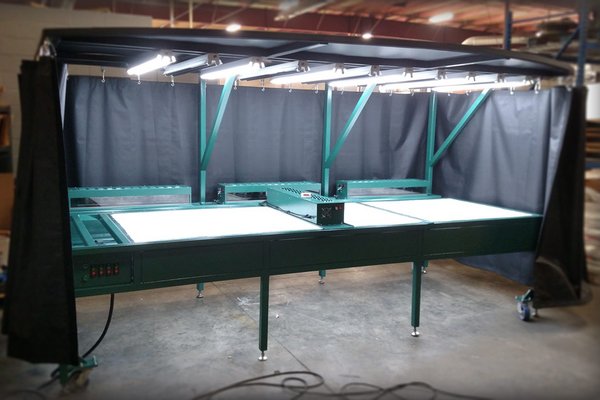
In plastic, paper, and woven/non-woven manufacturing, production flaws often arise from raw material inconsistencies or pressure roller issues. Landsco Inspection Tables are engineered to provide trouble-free off-line inspection of web substrates for defects, thickness consistency, and hollow points.
Substrate Consistency for Web Materials
In web substrate manufacturing, specifically involving plastic and paper materials, defects generated during processing often leave pinholes, thinning sections, and hollow points in the web. These flaws typically stem from primary material reductions, incorrect roller pressures, or accumulated dirt in machinery. Detecting these microscopic or structural inconsistencies requires specialized backlighting and stable surface inspection before final converting or winding.
LandSco® - Key Features & Operational Benefits
- Optimized Off-Line Quality Control: Ideally suited for constant web sample inspections, empowering production teams to quickly identify trends and adjust machinery during active production runs.
- Customized Illumination Zones: Tailor-made overhead and underside inspection areas configured specifically to each customer’s operational requirements and material widths.
- Integrated Advanced Lighting: Built-in high-performance Landsco ITL and Super H light systems designed to reveal hidden web defects, pinholes, and internal inconsistencies effortlessly.
Landsco® - Technical Specifications & Compatibility
- Machine direction: The light shines in the machine direction on the paper showing defects in the cross-machine direction such as scratches, pits, embosses, fibers bonded at one end, coating skips, calendaring problems.
- Cross machine direction: The light shines in the cross machine direction, showing defects in the machine direction such as scratches, pits, embosses, coating problems, doctor blade scratches, repetitive marks.
- Back lighting: The light is behind the translucent inspection surface, showing through the paper to show paper formation, opacity, foreign objects, and pinholes.
- Ultraviolet overhead: Used to bring out the application of any brighteners, either in the paper or in the coating process to look for the amount and evenness of application, or to check for any foreign particle that may fluoresce.
- Overhead Lighting: Used primarily for color rendition and evenness.
Not all manufacturing requires every option. The inspection tables can be custom-engineered to incorporate only the lighting options required based on the products being manufactured.
* This quality control tool has been proven to provide extremely quick ROI and has unrivaled acceptance as a tool all quality control managers should be relying on.
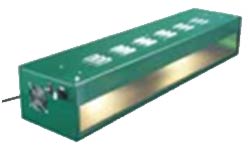
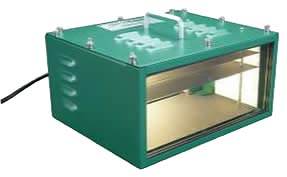
Utilizes one 300 watt lamp.
Inspection Table Light (ITL)
- ITL (short throw light) is designed to turn a flat, level surface into an inspection area of sizable proportions.
- Can illuminate surfaces from 40″ wide within 3″ from the light to 96″ wide just 48″ from the light, with an effective depth view of over 60″.
- All operating controls are located on the side of the unit for operator convenience.
Multiple ITL units can be used together on a common on/off and light intensity control for implementation in very wide format applications.
Model H / HA
- Used for on-machine inspection or can be mounted to an inspection table for off-machine inspection or table top use.
- Can illuminate surfaces 22″ – 96″ wide up to 140″ deep.
Model HA includes a remote control with a 12′ cable for dimming and on/off operation.
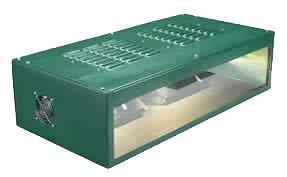
Model Super H
- Designed for large format viewing in the manufacturing of flooring, carpeting, gypsum board and door manufacturing or anywhere a large sample requires inspection.
- Can be located as close as 24″ from the sample and can illuminate a 65″ wide area to over 216″ wide at a 200″+ depth.
Offers twice the viewing area of the smaller Model H unit, but is just 30″ wide.
Industrial Applications
Landsco® Inspection Tables are heavily utilized across a wide variety of manufacturing and converting sectors handling continuous webs:
- Flexible Material Reels and Films
- Narrow Web and Pressure-Sensitive Label Stock
- Continuous Paper for Commercial Printing and Currency Production
- Vinyl, Fiberglass, Woven, and Non-Woven Industrial Materials